|
"It was very involved
because there are a tremendous amount of working parts in it,"
Sweeney describes. "There are probably a dozen separate controls
for different electric motors. The engine alone has three different
motors to make it work. There are electric actuators to make the
petals go in and out, as well as the main motor that counter-rotates
the two discs, top and bottom."
.jpg) When
it was completed, the time machine stood 10 feet, 6 inches high,
and weighed in at approximately 6,000 pounds, but its impact on
the cast and filmmakers was immeasurable. "I don't think
anything prepared us for finally seeing the actual time machine,"
Wells states. "It was one of those occasions when tears come
to your eyes. It was three tons of aluminum and polycarbonate,
but it sure looked like brass and glass. It was beautiful and
just awe inspiring." When
it was completed, the time machine stood 10 feet, 6 inches high,
and weighed in at approximately 6,000 pounds, but its impact on
the cast and filmmakers was immeasurable. "I don't think
anything prepared us for finally seeing the actual time machine,"
Wells states. "It was one of those occasions when tears come
to your eyes. It was three tons of aluminum and polycarbonate,
but it sure looked like brass and glass. It was beautiful and
just awe inspiring."
|
|
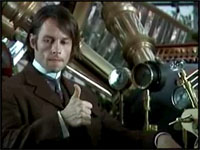 The
inspiration was especially felt by Guy Pearce, who would be the
one to actually step into the machine. "As an actor, you
do to a certain extent rely on your costumes, your makeup, your
props...to give you added insight into your character. The first
time I saw the time machine up and running, it gave me an incredible
sense of Alexander's ambition...the genius of this man." The
inspiration was especially felt by Guy Pearce, who would be the
one to actually step into the machine. "As an actor, you
do to a certain extent rely on your costumes, your makeup, your
props...to give you added insight into your character. The first
time I saw the time machine up and running, it gave me an incredible
sense of Alexander's ambition...the genius of this man."
In truth, however, they
were only part of the way there. Somehow they had to convey how
this Victorian machine manages to transport Alexander through
time. Wells comments, "We determined that the time machine
generates a sphere that becomes a self-contained area of time.
The essence of the time machine is that it stays in one place
and the world changes around it. It only travels through time,
not through space."
 The
computer generated time sphere was created by the visual effects
team, headed by visual effects supervisor James E. Price. "At
a certain point, the discs have to rotate at a rate that can't
be achieved practically. We took over and created a digital version
of the blades, which could spin at a much higher rate. Once they
were at a maximum we formed a CG light sphere that cocoons Alexander
as he travels through time," Price says. The
computer generated time sphere was created by the visual effects
team, headed by visual effects supervisor James E. Price. "At
a certain point, the discs have to rotate at a rate that can't
be achieved practically. We took over and created a digital version
of the blades, which could spin at a much higher rate. Once they
were at a maximum we formed a CG light sphere that cocoons Alexander
as he travels through time," Price says.
The effects artists
at Digital Domain handled the time-lapse images that visually
mark Alexander's passage through time. One of those sequences
was especially important to screenwriter John Logan. "When
I mentioned to anyone that I was writing 'The Time Machine,' the
one constant comment was that we had to keep the dress shop, so
the memorable dress shop, with its changing hemlines, is us tipping
our hat once again to the wonderful George Pal."
More dramatic and far
more challenging to the effects group was the journey through
8,000 centuries, in which we see vast geological and ecological
changes to the earth on a grand scale.
For the filmmakers,
remaking "The Time Machine" begs the question: If a
time machine really did exist, would you go?
"Not me,"
says Logan, stating, "As a writer, I would rather imagine
it than do it. Dreaming about the future is a real human need;
I wouldn't want to lose that by seeing the reality. Time travel
may well be coming someday, but I won't be taking the ride."
Guy Pearce shares his
trepidation. "I really don't know what I would do. I guess
we can't learn anything until we venture. But isn't one better
off venturing into the depths of the present moment where life
unfolds naturally, and the future and the past remain in their
true form-illusion?"
"For me, this
question always brings up the eternal time travel paradox: If
you went back in time and strangled your grandmother, you wouldn't
be born, so you couldn't go back and strangle your grandmother...,"
Simon Wells muses. "Even if you could travel back in time,
you can't alter the things that have happened to you because they
are what made you who you are, and that, in turn, informs the
decisions you will make in your future." "I think time
travel challenges one of the basic tenets of our existence,"
Walter Parkes reflects, "which is that we live in the present.
I think that fearfulness would ultimately keep me off of the time
machine, but, as the Uber-Morlock tells Alexander, we all have
time machines. The ones that take us back are called memories
and the ones that take us forward are called dreams. Maybe somewhere
in there is the elusive thing that makes us fascinated with time
travel."
|
.jpg) Simon
Wells acknowledges, "We all have a great affection for that
first movie, so from my earliest meetings with Oliver Scholl it
was a given that we had to have spinning discs. All time machines
have to have spinning discs," he smiles. "We experimented
with a number of different materials. Then I remembered that in
the original book the Time Traveler is referred to as a professor
of physical optics, which inspired the idea of using fresnel lenses-the
kind used in lighthouses-to form refractive petals."
Simon
Wells acknowledges, "We all have a great affection for that
first movie, so from my earliest meetings with Oliver Scholl it
was a given that we had to have spinning discs. All time machines
have to have spinning discs," he smiles. "We experimented
with a number of different materials. Then I remembered that in
the original book the Time Traveler is referred to as a professor
of physical optics, which inspired the idea of using fresnel lenses-the
kind used in lighthouses-to form refractive petals." 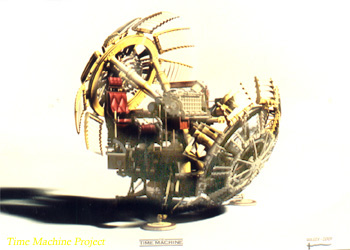 Wells
then turned over the approved concept sketches and illustrations
to computer designer Tim Wilcox, who was able to render a fully
three-dimensional digital model in the computer, which could be
seen from different angles, and could show how the movement might
work.
Wells
then turned over the approved concept sketches and illustrations
to computer designer Tim Wilcox, who was able to render a fully
three-dimensional digital model in the computer, which could be
seen from different angles, and could show how the movement might
work. .jpg) Taking
it from the virtual to the practical, model makers Dana Juricic
and Andrew Jones then crafted a scale model of the time machine,
which was used to refine the design, and work out surface textures,
how the pieces would fit together, and how an actor might fit in
the machine. Any modifications were passed back to Wilcox who adapted
them into his digital model of the time machine. From there, set
designer Darrell Wight produced the final blueprints, adding period
detailing and consistency to the design, so that special effects
supervisor Matt Sweeney and his team could turn form into function.
Taking
it from the virtual to the practical, model makers Dana Juricic
and Andrew Jones then crafted a scale model of the time machine,
which was used to refine the design, and work out surface textures,
how the pieces would fit together, and how an actor might fit in
the machine. Any modifications were passed back to Wilcox who adapted
them into his digital model of the time machine. From there, set
designer Darrell Wight produced the final blueprints, adding period
detailing and consistency to the design, so that special effects
supervisor Matt Sweeney and his team could turn form into function.